
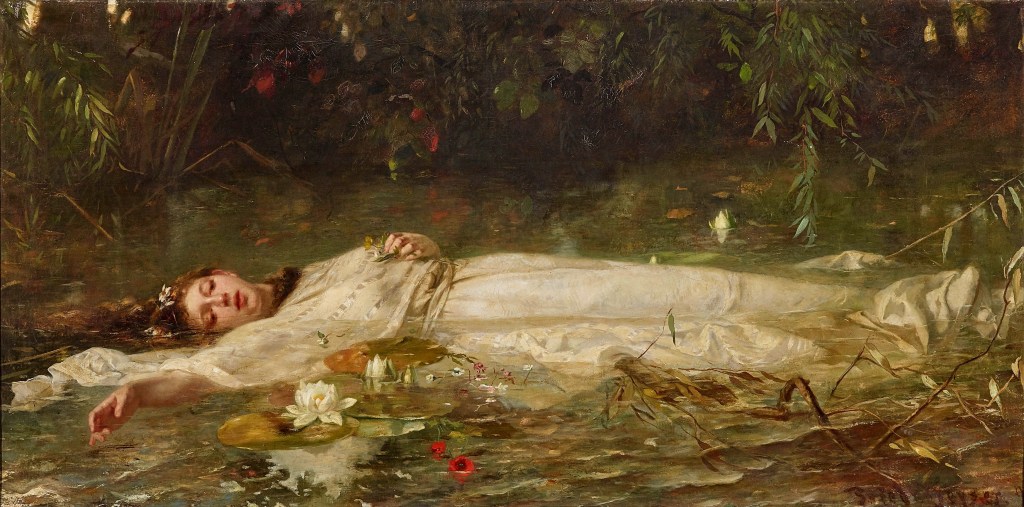
What does beauty mean to you? Would you be willing to protect beauty at all costs? Or would you condemn it, as it has been condemned throughout the millenia?
You probably have heard the story of the Sleeping beauty. But have you come across the original story, the italian version? Before I take you along to visit the original Sleeping Beauty story it is important to stress a crucial aspect about literature. Each literary work is connected, intertwined with previous works. Each writer is also a reader, and it is no wonder that previous readings inspire and transform the art of writing. This explains why the Sleeping Beauty is connected with previous ancient stories. It took inspiration from ancient classics, such as the Metamorphoses of Ovid. There’s a story there about Chione, a beautiful 14 year old girl. She was so beautiful that all men in Greece wanted to have her. One day two gods devised a plan to possess her body. Hermes, also known as Mercury went to her chambers, sent her to a deep sleep and attacked her. That night, while the girl was crying in her sorrow, Apolo visited her, disguised as an old woman pretending to confort her. He also attacked her.
Nine months later she gave birth to twins. One was white as the day and the other was black as the night. In her confusion, sorrow and pain she started to say she had been blessed by her beauty. That her beauty surpassed Athena’s. The cruel greek goddess, didn’t like to hear that. Athena had quite a reputation of punishing or killing her rivals, usually beautiful and accomplished woman. It is no wonder she decided to punish the teen girl. She killed her by shooting an arrow to her mouth and performed the ultimate condemnation of beauty.
Beauty is not about physical appearance. It is about an inner essence. It is about potential, creation, a force within the self. When it circulates around a world filled of broken and angry people beauty is most often punished and suffers attempts of destruction. When I was a teenager men used to approach me in the street saying the most obnoxious and disgusting things to me. My youth was attacked by those men. It isn’t about not being able to control themselves but the criminal desire to destroy, to purge and to taint the inner potential of beauty or of youth. Beauty in its original state is as if is divine. A divine confirmation of goodness. Destroying it at its core has been done since the beginning of times.
Fairy tales are a great means of incapsulating this human characteristic. Snow White’s mother tries to destroy the child for the beauty, the potential and future she sees before her eyes. Cinderella suffers the same fate by the action of her stepmother. Donkeyskin conveys how men, in this case the father himself, are determined to destroy their daughters. Talia, the original Sleeping Beauty, suffers her destruction by the actions of her father, the king. Afterwards, she faces condemnation by the hands of a queen.
The attack against beauty is never done solely by men. Some women complete the violence by placing the blame on the victim. The psychological implications are huge and should made us think, enquire, about every single time a woman is attacked and then questioned by a group of women about her purity, decency and modesty.
The wheel of destiny – Fortuna
By the year of 1634 the fairy tale, edited by Giambattista Basile, “Sun, Moon, and Talia” presented a tragic story: when Talia is born her father wants to know her destiny and for that purpose he hires the services of fortune tellers and astrologers. The conclusion couldn’t be more dire. Her father learns that a splinter of flax will be the source of great danger to her. Like any good father he decides to protect her. He forbids any raw material to enter in his property as well as any machinery usually associated to weaving and spinning. Generally speaking, every parent does what it needs to be done to provide security and safety to their offspring. However, the tale seems to be stressing the fact that he takes it to the upmost exageration. Talia grows into a young and a beautiful lady apparently not knowing anything about the world and there lies the danger. Her father protected her while not understanding his doings would be the real source of danger.
One day Talia sees an old woman spinning and she is so mesmerized by it that she leaves the house and takes the distaff from the old woman. And, for the first time, she starts to try to spin flax.
Taking the distaff from her hand, she began to stretch the flax. Unfortunately, Talia ran a splinter of flax under her nail, and she fell dead upon the ground. When the old woman saw this, she became frightened and ran down the stairs, and is running still.
The pain of having a splinter of flax under her nail is so intense that Talia isn’t able to deal with it. Growing up is always painful and for the young woman, not used to the world outside and to its dangers, this combination of events proves to be too much for her to endure. And so the enters into a deep sleep. She needs it to be able to deal with the new facts of life. And yes, the distaff and the spindle are quite meaningful in that sense. According to the dictionary of symbols the distaff is
“Separated from the simple, the distaff, a small rod, has a fallic and sexual meaning. It represents, not only the virile organ but also the thread of generations.”
The spindle, on the other hand, has the magic connotation of representing the wheel of time, the endless cycle of birth, life and death.
One thing is quite certain: trying to avoid destiny is always catastrophic. There is a literary tradition tied up to mytologhy that explicitly expresses the insanity of trying to run away from destiny. Her father has no power over her destiny. Against all his efforts she will grow up and will become a woman.
When Talia takes the distaff and starts to spindle she is participating in the never ending cycle of life and discovering how the feminine and masculine natures join together. Her young psyche isn’t ready for the complexity of the world and how things work, therefore, she must sleep until she is ready to embrace the fact she is no longer a child but a young woman.
It is clear what her father tried to achieve. When he decided that no flax would enter in property he was prohibiting the distaff and the spindle – the male and the destiny. Her father has, since her birth, tried to avoid his daughter to mature and to become an adult. But his disastrous decisions don’t end there. When he finds his daughter asleep he falls into a cycle of drinking and after that he places his sleeping daughter in one of his country houses. He seats her on a velvet throne, locks the mansion and leaves her all alone. Talia, the Sleeping Beauty, has now no one to protect her. The love and protection of her father were merely conditioned by her good behaviour. When she displays the alarming signs of becoming and adult and having a will of her own she is cast away. And this is why her father is again responsible for opening the door for tragedy and sorrow:
After a time, it happened by chance that a king was out hunting and passed that way. One of his falcons escaped from his hand and flew into the house by way of one of the windows. It did not come when called, so the king had one of his party knock at the door, believing the palace to be inhabited. Although he knocked for a length of time, nobody answered, so the king had them bring a vintner’s ladder, for he himself would climb up and search the house, to discover what was inside. Thus he climbed up and entered, and looked in all the rooms, and nooks, and corners, and was amazed to find no living person there. At last he came to the salon, and when the king beheld Talia, who seemed to be enchanted, he believed that she was asleep, and he called her, but she remained unconscious. Crying aloud, he beheld her charms and felt his blood course hotly through his veins. He lifted her in his arms, and carried her to a bed, where he gathered the first fruits of love. Leaving her on the bed, he returned to his own kingdom, where, in the pressing business of his realm, he for a time thought no more about this incident.
The narration is key here. It implicitly states that Talia has caused all this on her due to her beauty. The king was unable to resist her, it seems. And once again the perpetuation of the same violence once perpetrated against Chione still surpasses the pages of this fairy tale. Their fault is their beauty. Once again, nine months later, our heroine gives birth to twins, one girl and one boy. Her pain and trauma is so intense that she keeps being oblivious to her surroundings. Then, two fairies appear to help the babies to nurse from their mother. One day, for unknown reasons, the babies aren’t able to breastfeed and they start to suckle her finger. The splinter of flax is removed, and she wakes up.
The waking of the self
The king returns and he is extremely pleased to find out Talia has given birth to two beautiful babies. She doesn’t recall anything of the event and he happily informs her how he found her and impregnated her.
In the meanwhile the king remembered Talia, and saying that he wanted to go hunting, he returned to the palace, and found her awake, and with two cupids of beauty. He was overjoyed, and he told Talia who he was, and how he had seen her, and what had taken place. When she heard this, their friendship was knitted with tighter bonds, and he remained with her for a few days. After that time he bade her farewell, and promised to return soon, and take her with him to his kingdom. And he went to his realm, but he could not find any rest, and at all hours he had in his mouth the names of Talia, and of Sun and Moon (those were the two children’s names), and when he took his rest, he called either one or other of them.
The act of violence against Talia is swept under the carpet and she connects emotionally to her abuser in order to survive. In a time where violence against women wasn’t considered a crime she has no other alternative than to happily participate and to endure her destiny without complaining. Remember Chione? She did the same thing. When it seems useless to change reality the only alternative is to play along and to pretend happiness until reality and fiction are diluted. These tales serve the purpose to show the true and cruel dimension of reality. Countless women had no other way than to conform and to accept, with dissimulated joy, their cruel destinies.
Nevertheless, a new enemy arises. The king’s wife. When she finds out the affair she tries to kill Talia.
Chione and Talia have much in common. Being young and beautiful both suffer the consequences of the same crime they are victims. They both become mothers of twins and their life is at the fence by the powerful women of the stories. Athena, the goddess, hates whenever a woman, mortal or not mortal, endangers her power and position. Chione enters the long list of women condemned by the goddess. Some are killed with no mercy while others face a perpetual punishment of being transformed into a spider, as Arachne was, or transformed into a terrible monster, such as Medusa. In the classic greek myths, misogyny is not only perpetrated by men. Women take an important role of destroying their peers as suitable to them.
The king’s wife portrays this role. It is of no interest to her that Talia is indeed a victim of the King. Talia is a threat, someone who bewitched her husband and she must die. Similar developments are observed in infidelity cases where the wives tend to blame the mistress and to dismiss the abhorrent action of the husband. The abuse against beautiful women is common in these tales. The tale of Cinderella is a cautionary tale in that sense. Her beauty is a threat for her stepmother and stepsisters. Talia, the Sleeping Beauty, is just one more victim of this condemnation of beauty.
It is important to clarify that beauty is tightly knotted with the notion of youth. And that, in the eyes of society for millennia was the perfect alignment for tragedy. Wars were fought for the beauty of women, such as the Trojan war and kings committed crimes to get the women they wanted, such as King David and Bathsheba. And more often than not, women punished the victims. It’s no wonder the Handmaid’s Tale, by Margaret Atwood has had so much success. Violence against women isn’t perpetrated only by men. It is accepted and approved by women. Sara, from the biblical story, persuades her husband, Abraham to rape her slave, Hagar. After Hagar gives birth to a boy, Sara is violent towards her and some years later she convinces her husband to abandon the slave and the child in the wilderness to a certain death. In highly patriarchal societies women display misogynistic behaviours and beliefs in order to receive approval from those in power…
The king saves Talia from being killed and he kills his wife instead. Then he marries Talia, the young woman he attacked in her sleep.
And he never tired at playing the game of three with his wife and children, making a mill wheel of kisses, now with one and then with the other. (…) He married Talia to wife; and she enjoyed a long life with her husband and her children, thus experiencing the truth of the proverb:
Those whom fortune favors
Find good luck even in their sleep.
Most fairy tales portray acts of extreme violence against women. Contrary to popular opinion, it was not to justify those acts but to mimic the real world. Fairy tales were never meant to be told to children. They were meant to be told as cautionary tales, to act as an imitation of life: its cruelty and mercy. It is possible to imagine how these two previous stories would resonate so deeply with the women that had went through the same tribulations. Violence against women was normalized and the victims were left helpless in their pain and trauma. They should be silent and willing to be sacrificed in the altar of men’s pleasure and power.
A new Aurora
In the 1960’s a young woman faced her abuser and a society deeply rooted in misogyny. She was the first woman in Italy to break the chains of silence and to accuse publicly her abuser, taking him to court.
At that time, a man could attack a woman and avoid prison by marrying her. It was called the matrimonio riparatore, a law that forgave the abuser for his crime and restored the honor to the “damaged” victim and her family.
Franca Viola had been engaged to Filippo Melodia since she was 15 years old. However, when he was arrested for theft she broke off the engagement. Her ex-fiancé decided to abduct her and to abuse her for a week in order to force the marriage between them. Franca, was released after a week of severe physical violence and pressed charges against Melodia. Her decision caused turmoil throughout the society. Some defended her while others said she should marry Melodia to avoid becoming a dishonored woman for not marrying the man to whom she had lost her virginity to.
She won the case and he was sentenced to 11 years in prison.
Franca Viola’s courage set an important precedent and helped to end a legislative cycle of violence against women. In 1986 the law was finally abolished. It took time, indeed, but change takes time to occur. It is in the hands of every single one of us to create ripples in the sea of injustice and oppression in order for a new world to arise. A world where all human beings are truly protected against injustice and violence. Where everyone has the right to thrive, flourish and to be whole. Revolutions are not born from weapons but from ideas and dreams. Ordinary people like you and me who believe and dream about a better way to live. The original Talia would have been deeply moved to know that one day a single Italian girl was going to change her life and the lives of many others.
Ideas and solitary actions are more powerful than we think. We should dare to dream and to act accordingly. Step by step violence can be eradicated. And that is why it is worth to protect Beauty at all costs for the light will always prevail over darkness.
Beauty will save the world.
 The Literary Raccoon
Leave a comment