
Prefer reading? Go ahead. In the mood for a 10-minute video essay? Press play.
Fairy tales have been the most misunderstood form of literature. On one hand, people assume that fairy tales are just children’s literature. A weaker or lesser form of literary work. On the other hand, in recent decades, fairy tales have been accused of being gruesome, toxic and harmful. You see, this confusion comes from a deeper misconception about what fairy tales actually are.
Fairy tales are not children’s literature. Even Tolkien had to fight against the prejudice from his academic colleagues while writing one of the most famous fantasy worlds. In his essay, “On Fairy Stories” he presented his defense against the ignorance of the academic world about the role and place of fairy tales in literature. The 19th century saw a revival about everything that was related to folklore, tales and magic. However, that process infused all those stories of a childish tendency that never existed before. Suddenly, the fantasy world of past generations was just for little kids. But the truth is that princesses, fairies, godmothers, witches and dragons were never meant solely for children. They were for everyone. And especially for adults, for they offered something to those that had already faced the sorrows and difficulties of life. Fairy Tales were the result of the collective mind of humanity. And through them, lessons of wisdom and hope were transmitted by word of mouth.
The story of a young girl trapped in a loveless home, subjected to an evil stepmother and stepsisters wasn’t an uncommon reality. The main cause of death to women was childbirth, so it wasn’t unusual for a child to have a stepmother. In the worst cases the new mother was probably a cruel one. That’s why, many of those stories ended with a well matched marriage. It was a way to convey that girls should always try to escape their cages, their life constraints and to hope for better days. Without this collective chest of narratives most of the stories that entertain us so much wouldn’t exist. Fairy Tales exist as blueprints, oral stories that open the doors to a wonderful world. And that’s what fairy tales, as well as myths and legends are. A wonderful mystical cave filled with the ideas, feelings, desires, fears and longings that make humanity truly human.
Fairy tales flip the world upside down and subvert expectations. Cinderella isn’t a passive bystander. She pursues her freedom by going to the ball with the help of her godmother. In most stories, where there is a female protagonist, she is actually the one that saves the prince or a monster from itself. In Hans Christian Andersen story, the Snow Queen, it is a young girl who saves her beloved from the evil snow queen. In Hansel and Gretel, it is again the girl that saves her brother and destroys the evil crone. Folklore is filled with tales of courageous girls that face evil and leave victorious. Women as well as men, were given the role of saviors or destroyers. Although some stories portray helpless women, just like the case of the Sleeping Beauty, there are also many stories that function as counterparts and tip the scale and open news doors of perception.
Additionally marriage in fairy tales usually defied the social structure. But why the focus on marriage? In our modern days women have rights. They can vote, they can have autonomy over their own body, they can study, work without the consent of their fathers or husbands. Those rights were conquered just like a second ago. For too long, women were just property. And the only way they had to ascend socially, to escape from violence or poverty was through marriage. And in that sense, the husband became a savior. A good husband (even if he was a little bit awkward or not handsome) was considered a huge life improvement. As long as he was not violent or mean, women usually aspired to marry a good and kind man.
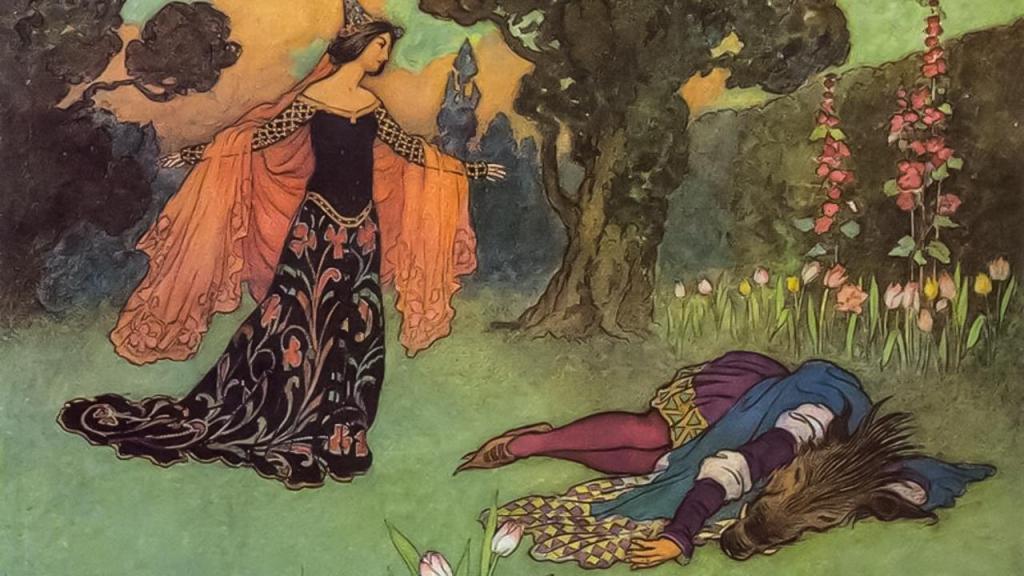
However, fairy tales present the dark side: the cruel Blue Beard and the true husband of the Sleeping Beauty. More often than not women had to deal with violent and cruel men through their marriage. And in these cases, their salvation usually arose from the outside or they had to conform to resignation and survival. There is no sugar coating or the attempt to brush under the carpet certain realities. That’s why, for instance, the Sleeping Beauty, in the original version, is awakened by her babies in extraordinary circumstances. It is a tragic and extremely dark tale and there’s no savior in that story. She has to marry the man that attacked her and made her pregnant while in her sleep. There are no magical kisses or shining princes. Ironically, those roles were generally given to young women, not men. The frog prince and the Beauty and the Beast are two relevant facets of this characteristic. However, the Disney film adaptations have, indeed, reinforced expectations that didn’t exist in the original stories for portraying meek, soft and fragile female protagonists. In doing so, much of their meaning and much of their magical power was lost. And, understandably, people started to drift way from the magical fantasy world of fairy tales. The audience that needed them most, adults facing real darkness, believed these stories were no longer for them.
Fairy tales are feared for their cruelty, violence and darkness. As I said before Fairy tales were created to mimic reality: mostly in a literal and also in a symbolic way. The mother becomes the evil witch who wants to destroy her daughter. Meanwhile, her daughter tricks death and survives through all kinds of hardships and ends up becoming a queen herself, while watching her mother dancing with hot iron shoes till her death. The daughter, Snow White, after eating the poisoned apple falls dead. In my view this moment is when she sees it clearly: her mother doesn’t love her and wants her dead. Snow White’s death is a symbolic one. She isn’t able to process the extreme pain of knowing she was never loved by her mother. The trauma is so devastating that the self protects itself by closing the door and falling into an internal sleep.
While in this age, we have access to therapy and mental health counseling, back then there were these containers of human wisdom. People were able to discern what was behind all those stories. It was through the telling and retelling, while sitting by the fire, that mental and emotional healing was able to take place. Those same stories that are accused of being toxic, were created by people, real people who lived in extremely harsh and dangerous environments. People like us, that experienced happiness, sorrow, good fortune and loss. And those stories were like touchstones of healing for the bruised hearts and minds. Through small gatherings of two, three or more women and men, young and old stories were shared. And they understood their importance and power. For they kept telling them for future generations.
Thankfully, men like the Brothers Grimm, in Germany, and Adolfo Coelho, in Portugal, saw the importance of that rich oral heritage. Those stories needed to be collected in order to survive through the ch anges of the last centuries. They had to be saved in paper, and compiled into books in order for its legacy to be preserved. If not, fairy tales would have been lost forever. If there is no one to tell the stories they disappear. And so a part of what makes us human, is lost. And there would be no one to remember Snow White and what she teaches us: that even the deepest sleep can end. And that’s their true magic power. Perhaps that is what knowing nothing about fairy tales truly costs us.
 The Literary Raccoon
Leave a comment