
Prefer reading? Go ahead. In the mood for a 10-minute video essay? Press play.
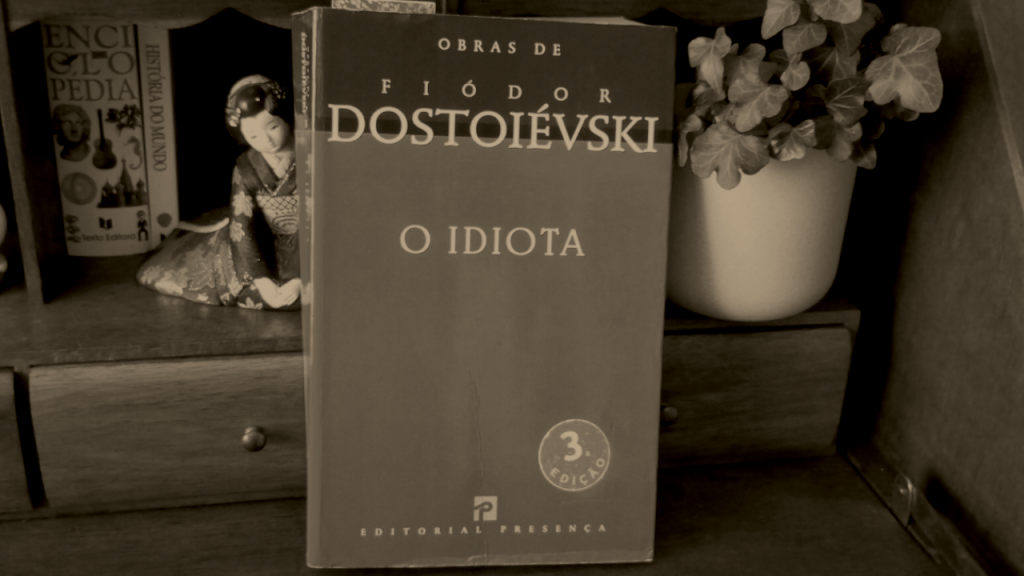
Although The Idiot is my favourite book I don’t have any particular insight about it. The Idiot is my favourite book because of what it makes me feel. There’s an awe that catches me, every time, I re-read it. This book changes continuously through the years.
The first time I read this book I was 23 years old. I was marveled by it. I knew I had stumbled into a precious thing. I made the mistake of recommending it to a friend. It was an error for it caused a lot of friction and bad discussions. I didn’t understand why it seemed we had read two different books, but in fact both had read the exact same edition. I was accused of not having understood the plot, the characters and main message of the book. That friend, who is no longer part of my life, presented a whole diagram of explanation for what had been for me a comforting and healing reading. The Idiot had been transformed by that person into a blueprint for life, a higher state of literary perception used to show how dumb and shallow my mind was.
This is a phenomenon widely well known: using the pseudo-intellectualism as a weapon to rise above others. This snobbism has always been around with a sole purpose: to gatekeep the access of culture from those deemed unworthy. That belief of inadequacy pushes people to consume content of higher academic value in order to achieve a loftier intellectual status. There are also those who decide to rebuke everything deemed intellectual due to the prejudice it conveys. Either path is a barrier against true fulfillment and growth. Who said you had to be an intellectual to enjoy reading the classics? And who told you there is a right way of reading those classics?
Lately I’ve been surprised by the number of classics that have an introduction written by an expert that explains the plot and present a whole range of interpretations to the story. I never read those introductions. I believe it kills the experience.
You only get one chance to read a book, watch a movie or play a video game for the first time. That first encounter is precious even if the experience was not really worth it. I earnestly believe in the importance of seeing the world by your own eyes and not by the lens of someone else. Consuming all types of information about a book, instead of reading it on your own is, in my opinion, the same as playing a new video game but following a detailed walkthrough made by someone else. There’s nothing wrong with those walkthroughs. In fact, they are a valuable help to complete a dungeon or to find a secret item in someplace distant.
However, not being able to play the game, to take that leap of faith by playing without any help, completely oblivious to the events unfolding is a sign of something endemic to the human being. We don’t like not knowing. We hate uncertainty, we hate unresolved mystery. We want facts and everything in their tiny and well ordered cabinet drawers. We extend that demand to the classics of literature. We refuse to accept that those books have a mind of their own or might be impossible to understand. That’s not allowed in our science-driven society.
We have been able, for a long time, to tame and domesticate the literary realm using academic authority to state the most pernicious lie: you need someone of authority to explain what those words mean. And we believed those lies.
Rainer Maria Rilke, in his famous Letters to a Young Poet, advises:
Read as little as possible of literary criticism — such things are either partisan opinions, which have become petrified and meaningless, hardened and empty of life, or else they are just clever word-games, in which one view wins today, and tomorrow the opposite view.
There is an array of interpretations of the Idiot. Books and many publications have been written about the narrative and symbolism of this work. I believe, unless you already have a well-formed opinion and an understanding of a book, you shouldn’t read any criticism or analysis about it.
The last time I read the Idiot was 2 years ago. I still keep thinking about it almost every week. Shouldn’t I browse the internet to read a well written article or a video essay about the topic in order to appease my mind? The question is: why should I? It is not as if I need to pass a school exam or something like that. What’s wrong with not knowing? Is it really that bad to keep wondering and to reminisce about an extraordinary book?
Each book should have a warning: read at your own peril, you have been warned. Books are dangerous. The second time I read the Idiot I kept wondering if, in some way, the book had been replaced by an entirely new book. Italo Calvino has an extraordinary explanation for that: “A classic is a book that has never finished saying what it has to say.”
That deceitful simple plot (and it is quite simple indeed) amasses a world of meaning, feelings and sensations. Do I grasp it all? No. And it doesn’t bother me. Because it means each time I return to it, it will be like a new book. A new world unfolding, once again, in front of my eyes.
People might argue that these types of books are solely for very smart people. It is a lie. A book that has been written by a human, was made to be read by humans. If a book seems to be difficult to understand, extremely boring and cryptic, perhaps it is simply because of two possibilities: it is the wrong time for you to read that book or that book is simply not good for you.
There is some kind of dogma, an unwritten command that places the literary classics on the higher ground. Untouchable, perfect and divine. That is also a lie. There are books, deemed classics that are completely abhorrent and atrocious. One can feel their life being pulled from them by spending an hour trying to survive the first chapters. And then we hear someone claiming that if you don’t read that book you are losing access to something crucial to your life and soul.
I believe that’s why so many people stop reading. They start to believe that the art of reading is elitist. That they don’t have the intellectual tools to read the classics. That’s also a lie. The truth is simple: you can’t force yourself to enjoy what you genuinely don’t like. And that’s ok. Everyone claims D. Quixote is the best thing next to the invention of electricity and I fall asleep every time I try to read it. I never fall asleep while reading a chinese fantasy novel, though…
There’s a movie I genuinely enjoy watching whenever I get a chance. It is called Liberal Arts. The protagonist criticizes a girl for reading Twilight. He decides to read the Twilight book in order prove his point and realizes that, although the book is horrendous, the story is quite compelling. The movie resonated immensely with me. It is easy to fall in the trap of believing that everything is already known and that there is a certificate of quality that dictates our lives in terms of culture and art.
Going back to Twilight… I bought the first three DVDs of the movie series. I never read the books and the movies are terrible. Except for the third one. But, overall it is a terrible story that could have been something amazing. However, the story has something addictive about it. It is highly entertaining and that’s enough for me. I like to make a huge bowl of popcorn and to sit on the sofa while it is cold, dark and raining outside and to watch the movies. They are pure entertainment. And that’s enough for me.
It is damaging to believe there’s a certain and right way to assess literature. A right way of reading the Rime of the Ancient Mariner or to interpret Shakespeare by the lens of a highly renowned literary essayist. Doing so, it is like someone using a walking stick in spite of being able to walk alone perfectly.
If you want to read the Idiot or another classic of literature you just need to read and that’s it. Let the text talk to you, give it time to resonate with your soul. Be brave to dive into the thoughts and worlds created by another human being. That person wrote the book for people like you and me. Great books were never written to become inaccessible monuments admired from a distance. And if in the first pages you are already sleepy or bored to death, it is not your fault. It is simply not the right book for you.
Toss it away and go find your book.
 The Literary Raccoon
Leave a comment